Think of the Voynich Manuscript's writing like a game of hangman. Every time you correctly guess the next letter of a word because you already know the letter before it, that's a point for "predictability." Every time you're stuck guessing blind, that's a point for randomness.
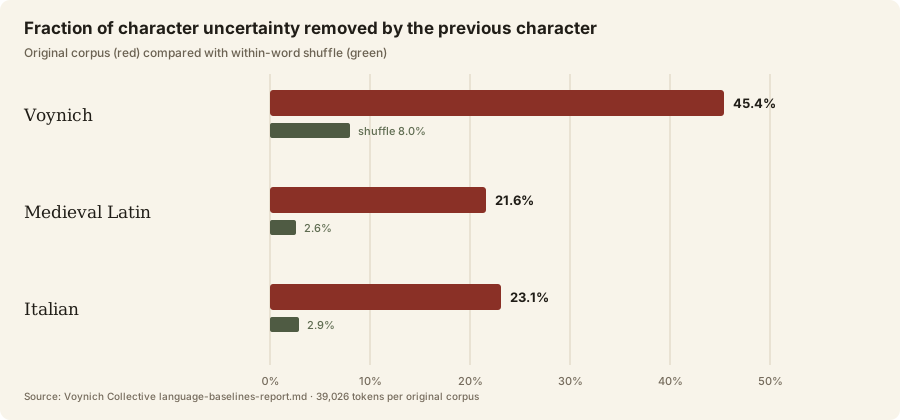
We ran this test — formally, it measures how much knowing one character narrows down the next one — on the entire transcribed manuscript, and then ran the identical test on real Latin and Italian texts of the same length for comparison. The result: knowing the previous letter in the Voynich Manuscript cuts your uncertainty about the next one by about 45%. In Latin, it only cuts uncertainty by about 22%. In Italian, about 23%. The Voynich text is roughly twice as internally constrained.
We didn't stop at two languages
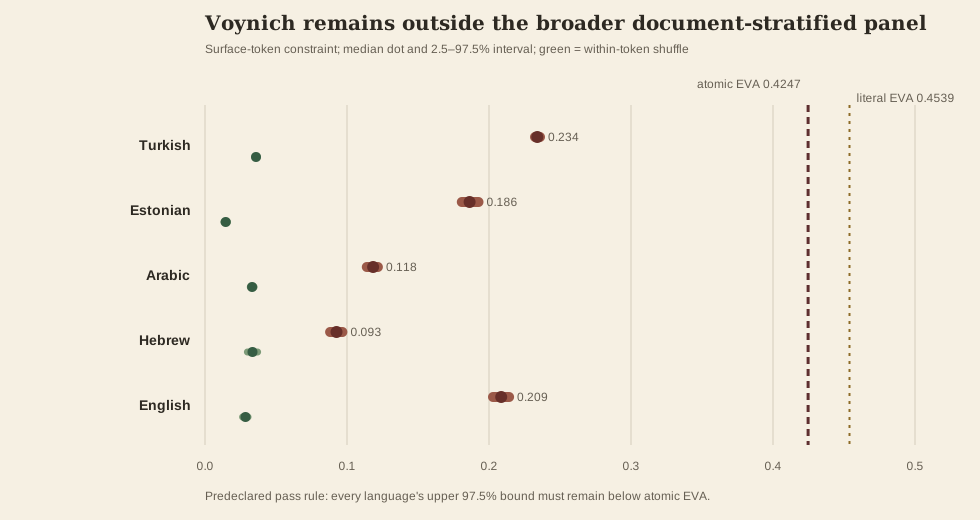
A gap between Voynich and only two comparison languages could be a coincidence, or a quirk of Latin and Italian specifically. So we built a bigger, pre-planned test: 200 matched samples each from five more languages with very different grammar — Turkish, Estonian, Arabic, Hebrew, and English. We wrote down exactly how the test would work, and what would count as a failure, before running it. Every single language stayed well below the Voynich Manuscript's number. The closest contender, Turkish, still fell short by a wide margin.
What this doesn't prove
This is an important result, but it is not a decoding. It doesn't tell us what language the manuscript is written in, whether it's a cipher, or whether it's meaningful text at all. Alphabet size, grammar style, and even how the original scribe abbreviated words could all still explain part of the gap. What it does show is that whatever produced this text was working under tighter internal rules than ordinary natural-language writing — a real, measurable, and now well-tested fact that any future explanation has to account for.